Implantologia
What is dental implantology?
Dental implantology is a branch of dentistry that aims to restore missing teeth through the insertion of artificial titanium roots ( dental implants ) provided, however, that there is sufficient bone to be able to place the endosseous implants.
In 1965, the Swedish Orthopedic Surgeon Per-Ingvar Brånemark operated on his first patient, Mrs. Gosta Larsson, with the insertion of four implants and a fixed prosthesis to correct a congenital malformation of the jaw. It was the beginning of Modern Implantology.
The operation proved to be a success: for the first time the patient was able to perform his masticatory and phonetic function normally, and when he passed away in 2006, he still had the implants inserted forty years earlier during the operation in good condition. pioneering.
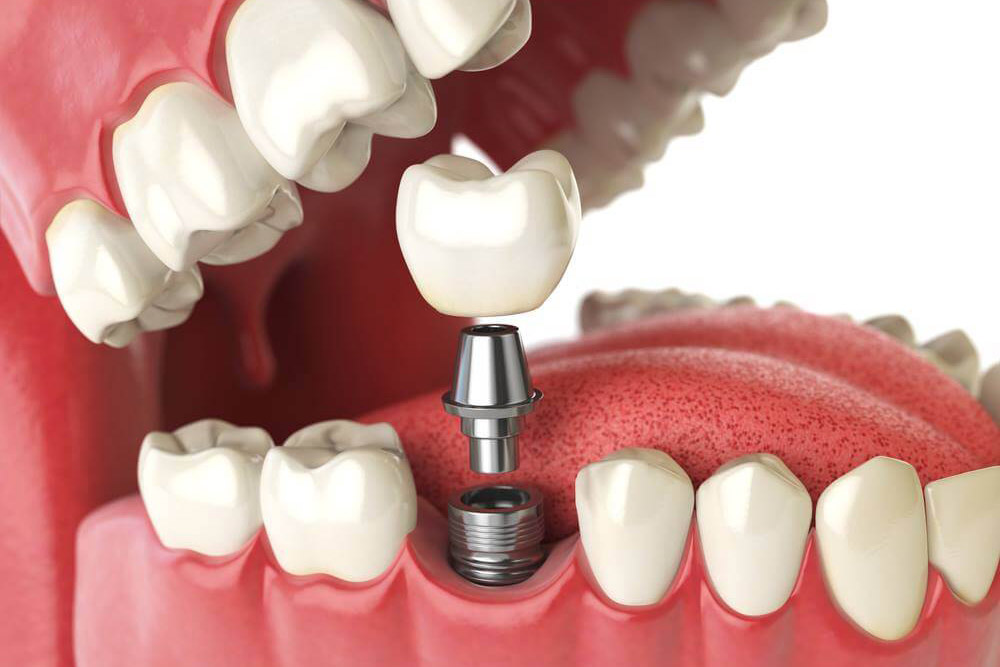
A dental implant is essentially a small titanium screw designed to replace the root of a missing natural tooth. Titanium is perfectly biocompatible; it is the same material used for the construction of orthopedic prostheses (e.g. knee, hip, femur, etc.). Dental implants are inserted into the bone where natural teeth used to be. Thanks to the biocompatibility of Titanium, the dental implant integrates perfectly with the bone and becomes a good anchoring point for the replacement tooth (crown).
In essence, implant dentistry is a rehabilitation procedure aimed at those who have lost their natural teeth.
Tooth loss: the causes
There can be many causes of tooth loss:
- mechanical traumas of various kinds;
- deep caries;
- periodontal diseases;
- other pathologies of the oral cavity.
The loss of one or more teeth causes a reduction in masticatory function which, in turn, causes a slow loss of mass and density of bone tissue
Characteristics
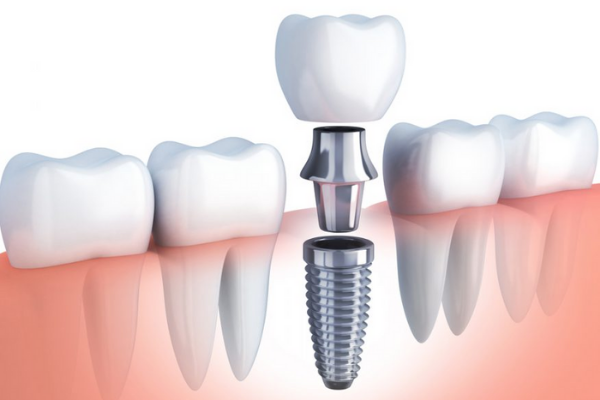
The dental implant consists of three main parts: the so-called endosseous screw , the so-called abutment (abutment or transmucosal component ) and the dental prosthesis (or artificial crown ).
- The endosseous screw is the element of the cylindrical and threaded dental implant which, following its insertion into the mandibular or maxillary bone, will undergo the process of osseointegration , i.e. the process of integration into the bone tissue. The solidity of the dental implant
depends on the endosseous screw and its insertion into the bone tissue ; for this reason, it constitutes the most representative portion. In a normal tooth, the endosseous screw is essentially equivalent to the root. - The abutment (abutment) is the element of the dental implant that connects the endosseous screw to the dental prosthesis.
After the insertion of the dental implant, it represents the portion in close contact with the gingival mucosa; this explains why it also takes the alternative name of transmucosal component.
- A dental prosthesis is what replaces the missing or extracted tooth or teeth. In fact, it is the external part of the dental implant, which has the task of covering the area without teeth.
It is important to remember that the dimensions of a dental implant – in this case of the endosseous screw – vary depending on the amount of maxillary or mandibular bone available: the more bone tissue is available, the greater the length of the endosseous screw; vice versa, the less bone tissue there is, the shorter the length of the endosseous screw.
What is osseointegration?
The term osseointegration defines the process of union between a bone and an artificial implant, such as the endosseous screw of dental implants. Based on current knowledge, the aforementioned union process takes place only when the artificial implant is made of titanium or metals extremely similar to the latter.
Types of Plants
There are at least two types of dental implant : the type in which the abutment (stump) is an integral part of the endosseous screw (the two elements form a single whole, therefore they are inseparable-cemented) and the type in which the abutment and the endosseous screw are two independent, separate parts.
Of the two possible types of dental implant just proposed, the most used is the second, as it is associated with simpler management and facilitates any repairs to damage that one of the various parts may suffer after installation.
Implant integration times and healing times
The dental implant surgery consists in the positioning of a titanium dental implant integrated into the bone of the affected dental arch ( osteointegrated implantology ).
The result is a stable bond between bone and dental implant that allows it to withstand high chewing loads.
The implant is left inside the bone and gum for the time necessary for osseointegration: the patient will not see any difference inside his mouth.
Usually, the integration time of the implant varies depending on the bone involved: maxillary (4-6 months); mandibular (3-4 months). Healing times
are estimated by the implantologist, also considering the factors that could slow down osseointegration.
In some cases, it is possible to place the dental implant without affecting the gum . This technique allows the surgical trauma of the operation to be reduced to a minimum, also shortening healing times.
After the osseointegration period, the uncovering of the implant is performed .
This is a small operation to be carried out before starting the final phase of creating the new tooth.
Uncovering the implant exposes its head in the oral cavity, through the use of healing screws which serve to adapt the gum.
Single system
When a tooth is missing and you want to fill the free space, there are two possibilities:
- Bridge between the two teeth lateral to the missing one;
- Single system.
In the first case it will be a matter of filing the two teeth lateral to the missing one, to accommodate a custom-made bridge of the filed teeth.
This solution has the disadvantage of having to damage the two healthy and functioning lateral teeth; this was a solution that was used more in the past, today we prefer to resort to Implantology.
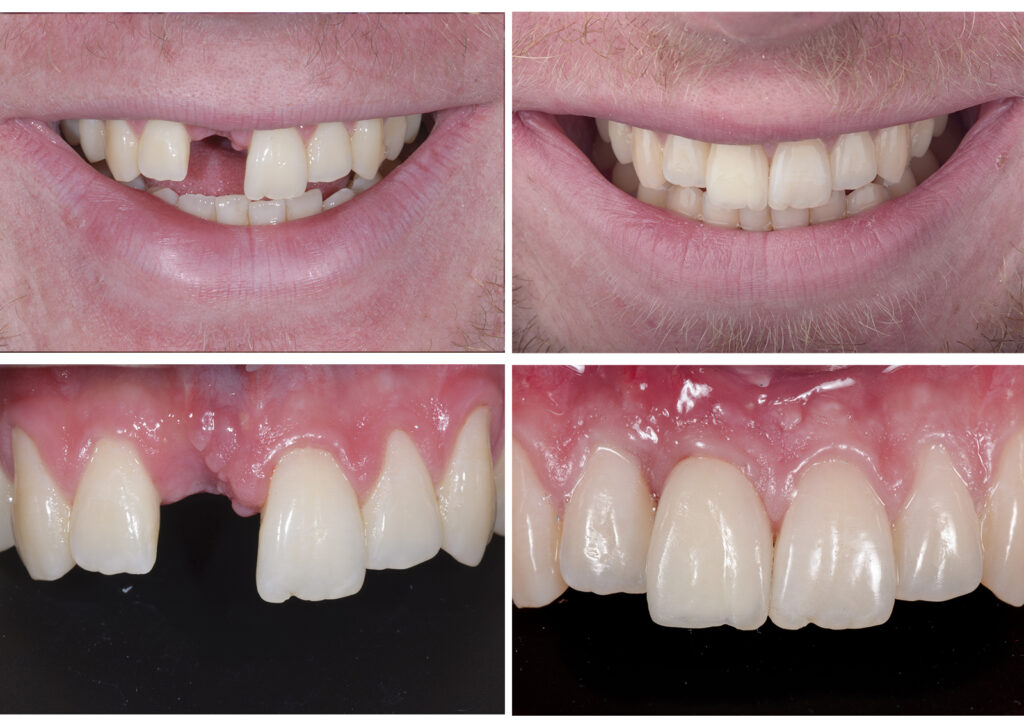
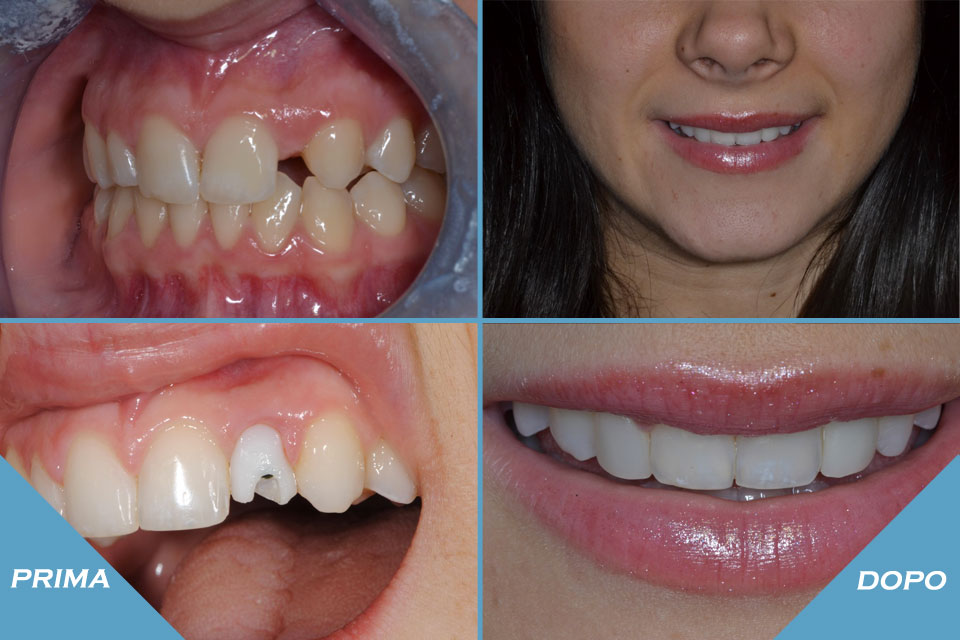
In the second case, a Titanium Dental Implant is positioned in the underlying bone, and the Crown (in Ceramic or Zirconium) is applied on it, which guarantees full chewing functionality as well as a very pleasant aesthetic.
Multiple system
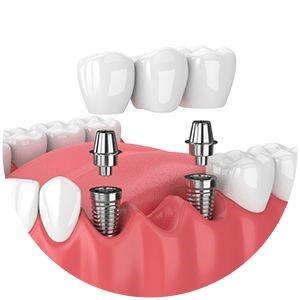
In this case, for example, the 3 missing teeth were replaced by a Bridge on 2 Implants; in this way the lateral teeth were preserved. When more than one tooth is missing, dental implants are positioned in some strategic points within the arch; These thus become solid foundations for the construction of a Fixed Bridge
Installations on the entire arch
Unfortunately, when more (agenesis) or all the teeth ( edentulism ) are lost in a single arch, for example due to trauma or periodontal disease or pyorrhea, complete arch implantology must be used.
This safe and well-tested technique for some time involves the positioning of several Dental Implants in some strategic points of the arch, which will have the function of supporting the entire arch which will subsequently be made of metal, ceramic or zirconium.
The choice of the number of implants to be placed (4 – 6 – 8) is the exclusive responsibility of the Implantologist Surgeon, and not – as often happens – according to the personal request of the Patient.
In fact, the Implant Surgeon, after having studied the 3D Cone Bean CT scan and the subsequent specialist visit with the patient’s medical history, will best evaluate the therapeutic case and decide both on the number of implants to place and also on the precise place where to place them.